


Street sounds and music have long been a site of class conflict dating back to the middle ages in BrItain. And in more recent times have prompted anti immigrant sentiment, In the early 19th Century repressive attempts to reign-in the threat of swarmery and mass insurrection amongst the ‘lower orders’ were regular. In The Street Music (Metropolis) Bill of 1864 ‘discordant sounds’ and ‘intrusive noise’ were first introduced as a category covering the “abominable nuisance” and “evil” of barrel and hand organs, trombones, trumpets, hurdy gurdies etc. played outside the homes of the governing class. Sir Robert Peel (3rd Baronet and son of the founder of modern policing and thus the old slang of “bobbies” and “peelers”), claimed that the lower orders were maliciously disturbing the peace and quiet of the idle rich as a form of blackmail.
“…. regularly every Saturday morning an Italian came and played the 100th Psalm on a hand organ. He sent his servant out on one occasion to request the man to vary the psalm; but he said he had not another in his repertoire. [[..]] Certainly they would never dream of going to Youghel where they could have no chance of levying blackmail.” Anyone visiting Bow Street in London in mid-June 2022 might have been a little perplexed or cheered by the joyous sight and sound of migrant workers assembled outside the Royal Opera House (ROH) with their trade union banners and flags, some in traditional Bolivian dress, singing, dancing to shake-your-feet drumming (exactly that which was targeted in the 1994 Criminal Justice Act), while up on the balcony those who’d come for the opera La Traviata, looked down dressed up to the nines, in formal evening dress, top hats etc., with cocktails and champagne in hand.
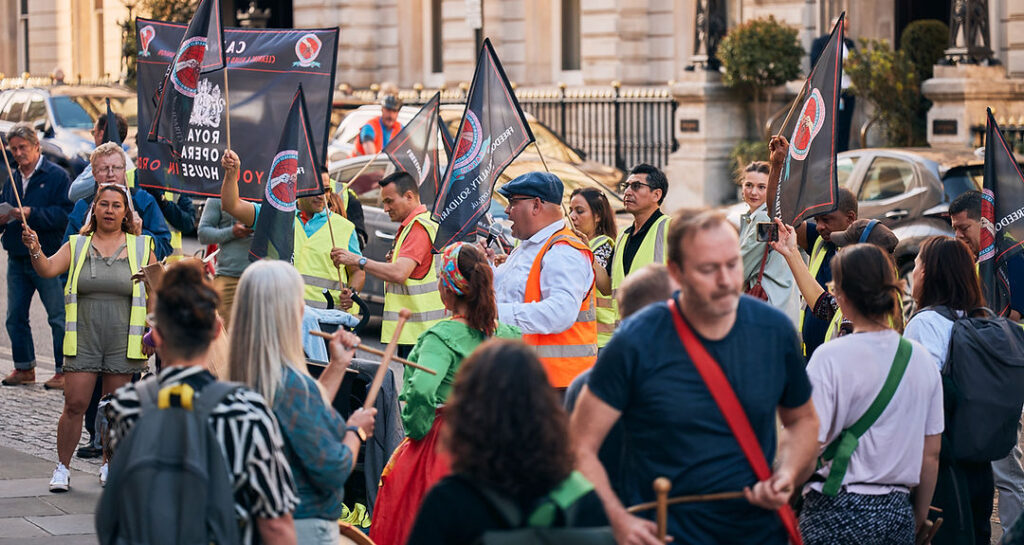
In this unexpectedly pronounced class stand-off, the dancing crowd was made up of those who clean up the mess of the balcony folk and the whole building. They were highlighting exploitation by ROH management and the outsourced cleaning company they employ to do their dirty work. This discordant clash of sounds/noise highlighted something else – a living, live, vibrant migrant London culture. So much so it would seem that rather than put their house in order and attend to racist employment practices, the ROH instead co-opted the protest and a year later, programmed their very own version in the form of Insurrection: “A Work In Progress explores the history of resistance in Barbados [[….]]. Taking its cue from the radical folk traditions of enslaved Black workers, this new performance piece celebrates the human need to gather, move, make music.
This blatant cultural theft does nothing to halt the creeping criminalisation of ‘discordant sounds’ and ‘intrusive noise’. The thrust of the Criminal Justice Act 1994 was to criminalise self-organised “Rave” gatherings of 20 or more people and their “repetitive beats”. In 2024 the Russian-backed government of Chechnya has gone a step further in outlawing any beat outside of 80-120 beats per minute These are the limits, No More, No Less!
Back in the UK newcoming property-owners in the Kilburn area of London tried to ban long-term residents’ outdoor games of dominos on account of being too loud. They failed. But the UK Police, Crime, Sentencing and Courts Act 2022 seeks to impose “conditions on unjustifiably noisy protests that may have a significant impact on others or may seriously disrupt the activities of an organisation”. Ah poor delicates, that we are in a city of everyday noise: sirens, heavy traffic, construction sites, adverts, constant tannoy instructions of the “See it, Say it, Sort it” variety and car alarms. The Act was specifically targeted, requested and demanded by the little known Carr Report: Review of the Law Governing Industrial Disputes from 2014 which sought to rein in the threat posed by unaffiliated migrant-led trade unions, by linking protest sounds to threats of intimidation, harassment, victimisation and ‘watching and besetting’. All of which were proposed as areas of new legislation to criminalise “protests which usually involve music (often live, South American music), speeches, drumming, banners, loudspeakers and vuvuzelas”, along with “speeches recounting the stories of cleaners”.